AI in the Workplace: How Artificial Intelligence Is Transforming HR, Sales, and Operations Together
AI Is No Longer a Future Idea — It Is Already Changing Daily Business Work
Artificial Intelligence is no longer limited to large technology companies or advanced research teams. Today, AI is becoming part of everyday business operations. From managing leads and customer follow-ups to organizing employee activity, automating workflows, and helping managers make better decisions, AI is changing how modern workplaces function.
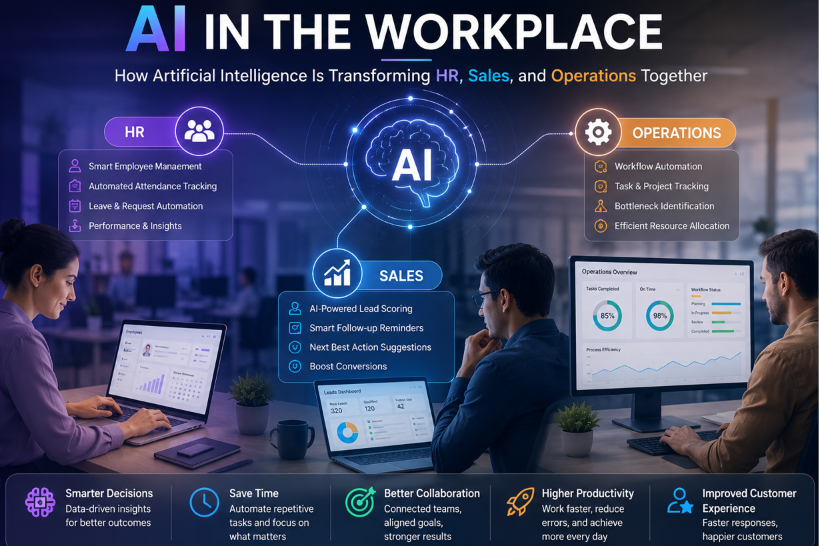
The biggest shift is that AI is not only improving one department. It is transforming multiple areas of a business at the same time. HR teams can use AI to organize employee records, track attendance patterns, simplify internal requests, and support better workforce management. Sales teams can use AI to prioritize leads, recommend next actions, and reduce missed follow-ups. Operations teams can use AI to identify bottlenecks, automate repetitive tasks, and improve daily workflow visibility.
In many businesses, HR, sales, and operations work separately. Each department uses its own tools, maintains its own data, and follows its own processes. This creates disconnected information. The sales team may know what customers are asking for, operations may know where delivery or service delays are happening, and HR may know where team capacity is weak — but if this data is not connected, the business cannot see the full picture.
This is where AI becomes powerful. AI works best when it can understand connected information. When your leads, team activity, workflows, customer records, and internal processes are managed in one platform, AI can help identify patterns that are difficult to notice manually. It can support better decisions, faster responses, and more organized work across departments.
The Real Problem: Businesses Have Data, But Not Enough Clarity
Most businesses are not suffering because they have no data. They are suffering because their data is scattered. Customer conversations are in one place. Lead records are in another. Employee updates are shared through messages. Reports are prepared manually. Tasks are managed separately. By the time a manager tries to understand what is happening, the information is already divided across too many tools.
AI cannot create real value if the business system is messy. If information is incomplete, outdated, or scattered, AI suggestions will also be limited. But when a business uses one connected platform, AI can work with cleaner and more meaningful data. It can help teams understand priorities, reduce manual work, and focus on actions that matter.
For example, if a sales team is handling many leads, AI can help identify which leads need urgent attention. If operations are facing repeated delays, AI can help highlight where the workflow is slowing down. If HR wants to understand team workload or attendance trends, AI can help organize the information into useful insights. The goal is not to replace people. The goal is to help people work smarter.
Why AI Works Better When HR, Sales, and Operations Are Connected
A business does not operate in isolated departments. Sales affects operations. Operations affects customer experience. HR affects team performance. Team performance affects sales results. When these areas are managed separately, the business only sees small parts of the story.
AI helps connect these dots. It can look across different areas of the business and support better coordination. If sales activity is increasing but team capacity is low, managers can plan better. If customer follow-ups are being missed by a specific team, managers can identify the issue earlier. If operational delays are affecting customer satisfaction, the business can respond before the problem becomes bigger.
This connected approach is one of the reasons businesses are moving toward unified platforms like tezway. Instead of using separate systems for leads, teams, workflows, communication, and reports, a connected platform allows businesses to organize work in one place and use AI to make that work more intelligent.
AI in the workplace is not just about automation. It is about visibility, clarity, and better decision-making. Businesses that understand this will not use AI as a shortcut. They will use it as a smarter layer on top of a strong business system.
How AI Is Transforming HR, Sales, and Operations
AI becomes most valuable when it solves real business problems. For HR, the problem may be managing employee activity, attendance, internal requests, and team performance. For sales, the problem may be missed leads, slow follow-ups, and poor visibility into the pipeline. For operations, the problem may be repetitive work, unclear task ownership, and delays in daily processes.
When AI is used properly, it can support all three areas at the same time. It can reduce manual effort, organize scattered information, and help teams act faster. This is especially important for growing businesses where managers cannot manually track every lead, employee update, customer request, and operational task at once.
AI in HR: Smarter Workforce Management
HR is not only about hiring and payroll. In a growing business, HR is responsible for keeping the workforce organized, informed, and productive. This includes attendance tracking, employee records, leave management, internal communication, onboarding, performance visibility, and policy-related workflows.
AI can help HR teams move from manual administration to smarter workforce management. Instead of spending hours checking records, preparing summaries, or identifying gaps manually, AI can help highlight important patterns and organize information more clearly.
- Attendance insights: AI can help identify repeated late check-ins, absence patterns, or unusual attendance behavior that may need management attention.
- Employee support: AI can assist with common internal questions, helping employees get faster answers without waiting for manual responses every time.
- Onboarding assistance: New employees can be guided through company processes, tools, and responsibilities more smoothly.
- Performance visibility: AI can help managers understand workload, activity trends, and areas where team members may need support.
- Document and request organization: HR-related requests, approvals, and records can be easier to manage when AI helps structure and categorize them.
AI in Sales: Better Leads, Faster Follow-Ups, Stronger Conversions
Sales teams deal with speed and timing. A lead that is handled quickly has a better chance of moving forward. A lead that is ignored, delayed, or poorly followed up can easily be lost. This is where AI can make a major difference.
AI can help sales teams understand which leads need attention first, what action should happen next, and where follow-ups are being missed. Instead of treating every lead the same way, AI can help prioritize work based on customer interest, lead status, previous activity, and pipeline movement.
- Lead prioritization: AI can help identify which leads may require urgent follow-up based on activity and status.
- Next action suggestions: Sales agents can receive guidance on whether to call, message, follow up, or update the lead stage.
- Follow-up reminders: AI can reduce missed opportunities by helping teams stay on top of pending customer interactions.
- Customer conversation support: AI can help summarize customer interactions and make it easier for teams to understand the lead history.
- Pipeline visibility: Managers can see which leads are active, stuck, delayed, or ready for conversion.
AI in Operations: Less Manual Work, More Control
Operations is where daily business execution happens. Tasks need to be assigned, services need to be delivered, workflows need to move forward, and teams need to stay aligned. When operations are managed manually or through scattered tools, delays become common.
AI can help operations teams identify bottlenecks, automate repetitive steps, and improve process visibility. It can support managers by showing where work is stuck, which tasks need attention, and how different parts of the business are performing.
- Workflow automation: Repetitive tasks can be reduced through smart triggers, reminders, and structured processes.
- Bottleneck detection: AI can help identify where tasks, leads, or customer requests are slowing down.
- Task ownership clarity: Teams can better understand who is responsible for what and what needs to happen next.
- Operational reporting: Managers can receive clearer summaries of daily activity, pending work, and process performance.
- Improved coordination: Operations teams can work more smoothly when tasks, updates, and communication are managed in one system.
The Real Power Is Not AI Alone — It Is Connected AI
AI is helpful in individual departments, but its real value appears when it connects HR, sales, and operations together. A business does not only need smarter lead management or smarter HR records. It needs a connected system where each department supports the other.
For example, if the sales team is generating more leads than the operations team can handle, AI can help highlight capacity pressure. If employees are overloaded, HR and management can see the pattern. If customer follow-ups are delayed because of unclear ownership, the system can help identify where the process is breaking.
This is the type of intelligence businesses need: not isolated automation, but connected decision support. A unified platform like tezway helps businesses move toward this model by keeping leads, workflows, teams, communication, and operational activity closer together.
Why Businesses Need an AI-Powered Unified Platform
Many businesses try to use AI by adding separate tools on top of already scattered systems. One AI tool for writing messages, another for reports, another for chat, another for analytics, and another for customer support. While this may help in small areas, it does not solve the bigger problem: the business still remains disconnected.
The better approach is to use AI inside a unified platform where business data, team activity, customer records, workflows, and communication are already connected. This allows AI to understand the bigger picture instead of working with limited information from one department only.
Signs Your Business Is Ready for AI in the Workplace
- Your team is spending too much time on manual updates: If employees are repeatedly entering the same information, preparing manual reports, or chasing updates, AI can help reduce this workload.
- Your leads are not being followed up properly: If potential customers are being missed because your team lacks reminders or prioritization, AI-powered lead management can help.
- Your managers do not have real-time visibility: If decisions depend on outdated reports or verbal updates, AI can support faster and more informed decision-making.
- Your HR processes are becoming difficult to manage: If attendance, employee records, leave requests, and internal support are scattered, AI can help organize and simplify HR operations.
- Your operations depend too much on memory: If tasks, approvals, and workflow steps are not tracked properly, AI can help create a more structured process.
- Your business is growing but your systems are not: Growth increases complexity. AI can help manage that complexity when it is built into a connected platform.
How tezway Helps Businesses Use AI More Practically
tezway is built for businesses that want to manage leads, teams, workflows, follow-ups, communication, and daily operations from one organized platform. Instead of treating AI as a separate add-on, tezway supports a more connected approach where AI can help improve how work is managed across different areas of the business.
In sales, tezway can support better lead tracking, follow-up management, and pipeline visibility. In operations, it can help teams organize workflows, reduce confusion, and maintain clearer task ownership. In team management, it can help create better visibility around activity, communication, and work progress.
The goal is not to make businesses depend completely on AI. The goal is to give teams better support. AI should help people make smarter decisions, avoid missed opportunities, and reduce repetitive work. When used properly, it becomes a productivity layer that supports the entire organization.
AI Will Not Replace Good Teams — It Will Empower Them
One common misunderstanding about AI is that it is here to replace employees. In reality, the most practical use of AI in the workplace is to help teams perform better. AI can handle repetitive checks, summarize information, suggest next steps, and highlight important patterns, but people still make the final decisions.
A sales agent still understands the customer relationship. An HR manager still understands employee needs. An operations manager still understands business priorities. AI simply gives them better information, faster access, and more structured support.
This is why businesses should not think of AI as a replacement for human judgment. They should think of it as a smart assistant inside the workplace. It helps teams reduce wasted time, improve consistency, and focus on higher-value work.
The Bottom Line
AI is transforming the workplace because businesses need better speed, better visibility, and better control. HR needs smarter employee management. Sales needs stronger lead handling. Operations needs smoother workflows. Management needs clearer insights. When all of these areas are connected, AI becomes much more useful.
The businesses that benefit most from AI will not be the ones using the most tools. They will be the ones using connected systems where AI can support real business processes. A unified platform makes that possible by keeping important information in one place and giving teams a smarter way to work.
If your business wants to reduce manual work, improve follow-ups, organize teams, and make better decisions, it may be time to bring AI into the workplace through one connected platform. With tezway, businesses can move toward a smarter, more organized way of managing HR, sales, and operations together.
To explore how tezway can help your business use AI more practically across daily operations, visit tezway.com and take the next step toward a smarter workplace.




Comments (0)
Leave a Comment
Your email address will not be published. Required fields are marked *