Why Your Business Needs One Unified Platform Instead of 10 Different Software Tools
The Modern Business Problem: Too Many Tools, Too Little Control
Most growing businesses do not start with a complicated software setup. They usually begin with one simple tool to manage one simple problem. A spreadsheet for leads, a messaging app for team communication, a task manager for daily work, a separate tool for reports, and maybe another system for customer records. At first, this feels manageable.
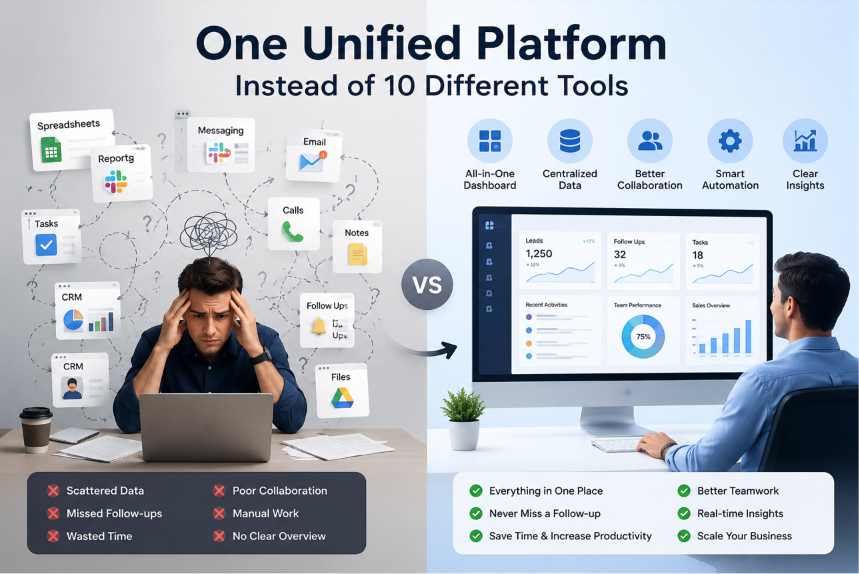
But as the business grows, this setup slowly becomes a problem. What once looked flexible starts becoming messy. Your team has to switch between different platforms. Customer information gets stored in different places. Follow-ups are missed because no one has a single clear view of what needs to happen next. Managers spend more time asking for updates than making decisions.
This is the hidden danger of using too many disconnected software tools. Each tool may be useful on its own, but when they do not work together, they create friction inside your business. Instead of helping your team move faster, they slow everyone down with repeated logins, duplicate data entry, scattered records, and unclear workflows.
Why Multiple Tools Create Confusion Inside a Growing Business
Imagine a new lead comes into your business. The customer details are added to one system. The conversation happens on another platform. The follow-up reminder is noted somewhere else. The manager is tracking performance in a separate report. The team member handling the lead may have their own notes saved privately. Now, when someone asks, “What is the current status of this customer?” there is no single answer available instantly.
This is where businesses start losing control. Not because the team is careless, but because the system is scattered. When information lives in too many places, even a good team can make mistakes. A follow-up can be delayed. A lead can be assigned twice. A customer can receive the wrong update. A manager can make a decision based on incomplete data.
A business needs one clear source of truth. Everyone should know where to find the latest lead status, customer history, task update, and workflow progress. Without that clarity, daily operations become dependent on guesswork, manual checking, and unnecessary communication.
The Real Issue Is Not Software Quantity — It Is Software Disconnection
The problem is not that businesses use software. Software is necessary. The real problem is using too many tools that do not speak to each other. When your lead management system is separate from your communication records, and your reports are separate from your team activity, your business loses visibility.
This is why a unified platform is becoming more important for modern businesses. Instead of spreading operations across 10 different tools, a unified platform brings the important parts of your business into one connected environment. Leads, customer records, team activity, follow-ups, services, sources, workflows, and reporting can all be managed from one place.
tezway is built around this same idea: helping businesses simplify operations by giving teams one organized platform to manage their daily work. Instead of depending on scattered tools and manual updates, businesses can create a cleaner, faster, and more professional workflow.
The Hidden Cost of Using 10 Different Software Tools
Many business owners only look at software cost in terms of monthly subscriptions. But the real cost of using too many tools is much bigger than the amount paid for each platform. The real cost appears in the form of wasted time, missed opportunities, weak communication, duplicate work, poor reporting, and frustrated employees.
Every time your team switches from one tool to another, they lose focus. Every time customer data is copied from one place to another, there is a chance of error. Every time a manager needs to open multiple dashboards to understand business performance, decision-making becomes slower. These small delays may look normal in daily work, but over time they create serious operational damage.
What Disconnected Tools Are Actually Costing Your Business
The biggest mistake businesses make is thinking that “more tools” means “more control.” In reality, too many disconnected tools often create the opposite. Your business may have more apps, more dashboards, and more subscriptions, but less clarity.
- Lost productivity: Team members waste valuable time switching between tools, searching for information, updating the same data repeatedly, and asking others for missing context.
- Missed follow-ups: When lead tracking and communication are not connected, important follow-ups can easily be forgotten or delayed.
- Scattered customer records: Customer information may exist in multiple places, making it difficult to know which record is latest and accurate.
- Weak reporting: Managers cannot get a complete business view if sales, team activity, customer updates, and workflow progress are stored separately.
- Duplicate work: Employees may need to enter the same information into different tools, which wastes time and increases the chance of mistakes.
- Training difficulty: New team members take longer to become productive because they have to learn multiple systems instead of one clear platform.
- Poor accountability: When tasks and updates are scattered, it becomes harder to know who handled what, when it was updated, and what still needs attention.
Why One Dashboard Makes Business Management Easier
A unified platform gives your business one dashboard where important information can be managed and reviewed easily. Instead of opening separate systems for leads, tasks, customers, reports, and team updates, your business can work through one connected platform.
This creates better visibility for managers and better clarity for employees. A manager can quickly see what is happening inside the business. A team member can instantly understand what needs to be done next. Customer records stay cleaner because information is stored in one place. Follow-ups become easier to track because the process is centralized.
The result is not just better software management. The result is a better business process. When everyone works from the same platform, teams become more aligned, communication becomes clearer, and customers receive faster responses.
How tezway Helps Reduce Operational Complexity
tezway helps businesses move away from scattered workflows and toward a more organized operating system. It allows businesses to manage leads, customer details, services, sources, follow-ups, workflows, and team activity in one central place.
For a growing business, this matters because growth creates complexity. More leads, more customers, more team members, and more daily tasks can easily overwhelm a weak system. If your business is already struggling with scattered tools, growth will only make the problem bigger.
A unified platform like tezway gives your business a cleaner foundation. It helps your team stay focused, reduces unnecessary manual work, and gives management a better view of daily operations. Instead of managing 10 different tools, your business can manage one connected system built for clarity and control.
How to Know Your Business Is Ready for a Unified Platform
Many businesses do not immediately realize that their software setup is slowing them down. The problems often appear normal at first. A team member forgets to update a lead. A manager asks for a manual report. A customer follow-up gets delayed. Someone cannot find the latest customer information. These issues may look small individually, but together they show that the business has outgrown its current system.
If your team is spending more time managing tools than managing customers, it is a sign that your software stack needs to be simplified. A business system should make work easier, not create more work. When tools become a burden, switching to one unified platform becomes a practical business decision.
Clear Signs Your Business Needs One Unified Platform
- Your lead data is scattered: If lead information is stored in spreadsheets, chats, notes, and separate apps, your team does not have a reliable view of the sales pipeline.
- Your team keeps asking for updates manually: If managers constantly need to ask, “What happened with this lead?” or “Who is handling this customer?” your system is not providing enough visibility.
- Your reports take too much time: If performance reports require manual data collection from different tools, your reporting process is inefficient.
- Your follow-ups are not consistent: If potential customers are being missed because reminders are not properly tracked, your business is losing opportunities.
- Your employees are using too many apps: If daily work requires switching between multiple tools, productivity is being lost silently.
- Your customer experience is becoming slow: If your team cannot respond quickly because information is not available in one place, the customer experience suffers.
Why tezway Is Built for This Exact Problem
tezway is designed for businesses that want to bring their operations into one organized platform. It helps teams manage leads, track follow-ups, maintain customer records, organize services and sources, and improve workflow visibility without depending on too many disconnected tools.
Instead of treating lead management, customer tracking, team updates, and reporting as separate problems, tezway helps connect these areas into one smoother process. This gives businesses better control over daily operations and helps teams work with more confidence.
What Makes a Unified Platform Better for Long-Term Growth
Growth becomes difficult when your systems are weak. A business can handle scattered tools when it is small, but as the number of customers, leads, employees, and workflows increases, disconnected systems start breaking down. More people need access to accurate information. More decisions need to be made quickly. More follow-ups need to be tracked properly.
A unified platform prepares your business for this growth. It gives your team a standard way to work. It helps managers monitor performance. It keeps customer data organized. It reduces the risk of missed opportunities. Most importantly, it gives the business a clear operational structure.
The Bottom Line
The future of business management is not about using more tools. It is about using smarter, more connected systems. A business that runs on scattered software will always struggle with visibility, speed, and consistency. A business that runs on one unified platform can move faster, serve customers better, and make decisions with more confidence.
If your business is tired of scattered data, missed follow-ups, manual updates, and too many disconnected tools, it may be time to simplify your system. With tezway, you can move toward one organized platform that helps your team manage leads, workflows, customers, and operations from one place.
To explore how tezway can help your business replace scattered tools with one connected platform, visit tezway.com and take the next step toward a more organized business workflow.

Comments (0)
Leave a Comment
Your email address will not be published. Required fields are marked *